
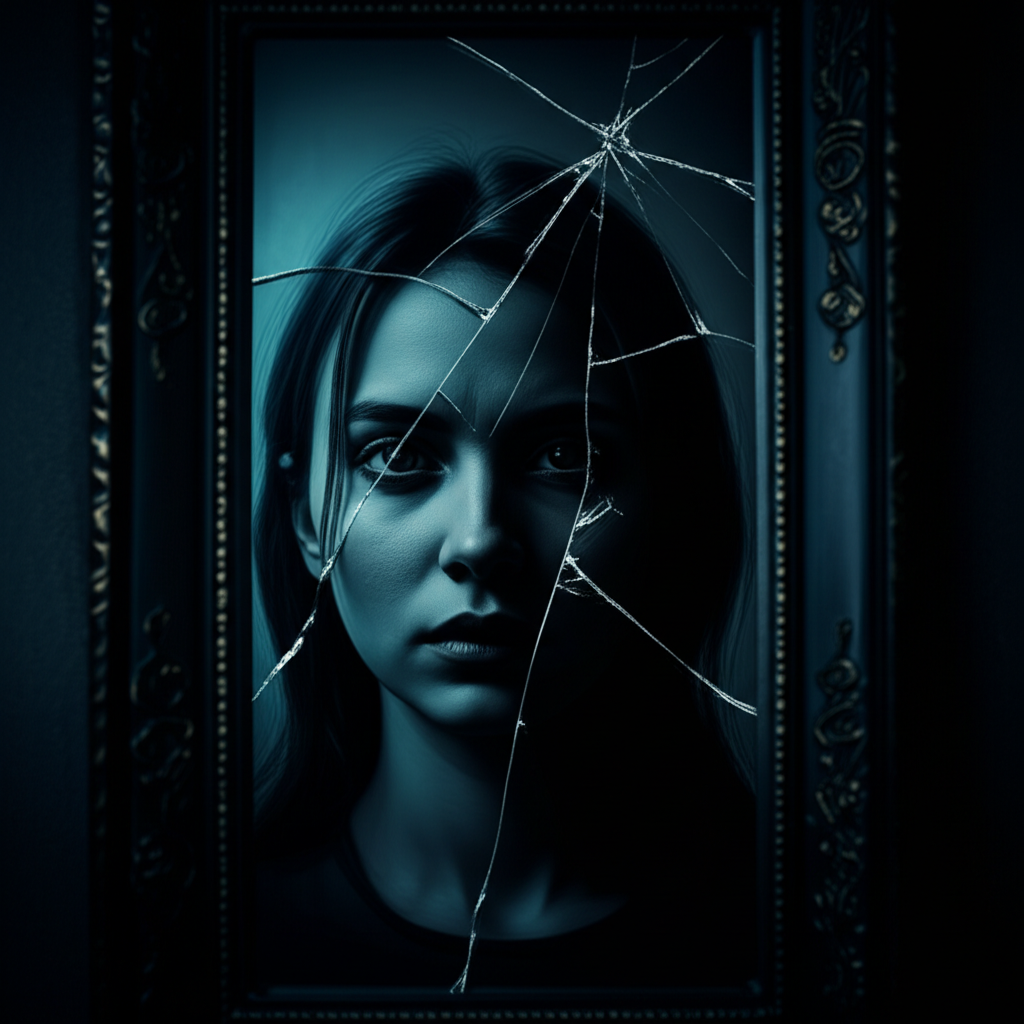
Cold Scream: Haunting Memory’s Reflection
The old Volvo coughed its last gasp just as the gravel drive gave way to the cracked flagstones of the lake house. Elara killed the engine, the sudden silence heavy, unbroken by the usual hum of town life. Only the wind, whispering secrets through the ancient pines, and the distant, rhythmic slap of waves against the shore remained. She leaned her head against the cool glass of the window, peering through the gloom. The house, long vacated by her parents, stood like a mausoleum against the bruised sky – a sentinel of her past, a monument to a buried grief.
Twenty years. Twenty years since she’d last set foot in this place, fleeing its oppressive quiet and the echoes of a life irrevocably broken. Now, the weight of her inheritance—the house, the land, the inescapable memories—had dragged her back. It was a pilgrimage of penance, a forced confrontation with a truth she’d meticulously walled off. The air, even before she stepped out, felt cooler, sharper, carrying a faint scent of damp earth and rust. A shiver, not entirely from the cold, snaked down her spine. This wasn’t merely a house; it was a reliquary of psychological horror, waiting for her return to unleash its contents.
Her hand trembled as she slid the key into the lock. The brass was cold beneath her fingers, the mechanism stiff with years of disuse. A faint click echoed through the hollow interior as the door creaked open, revealing a cavern of dust motes dancing in the slivers of weak sunlight that pierced the grimy windows. Everything was shrouded in white sheets, ghostly forms beneath. The furniture, the grand piano, the forgotten toys in the corner of the living room – all cloaked, as if preserving them from the ravages of time, or perhaps, from her own gaze.
A profound sense of unease settled over her. This wasn’t just old dust; it felt like frozen time, a static charge in the air. She remembered her therapist’s words, “Confrontation is the first step towards healing, Elara. Don’t let your memory define you, control you.” But here, the very air seemed to throb with definition, and control felt a distant, unattainable luxury. She moved deeper into the house, her footsteps unnaturally loud on the warped floorboards. Each creak, each groan of the settling structure, seemed to whisper her name, a prelude to the terrifying reflection that awaited her. She knew, with a certainty that chilled her to the bone, that the horrors she had sought to escape were not only within these walls but within herself, too.
Shards of the Past
The first night was a blur of unpacking minimal essentials and navigating the oppressive silence. Elara found a functioning lamp, its weak glow casting long, dancing shadows that made the dusty sheets seem to writhe. She tried to clean, to impose some order, but the sheer effort of scrubbing away years of neglect felt futile. The ingrained grime was a testament to the passage of time, a physical manifestation of the dust that had settled over her own past. Every object she uncovered, every forgotten photograph, was a shard, sharp and painful, threatening to cut through the protective callus her mind had built.
One such shard materialized while she was clearing out the small, cluttered study her father had once used. Beneath a stack of yellowed newspapers, she found an old wooden music box. Intricate carvings adorned its surface, faded but familiar. It was Lily’s. Her sister’s. A wave of nausea washed over Elara. She hadn’t seen this in decades. Her parents, in their grief, had purged most of Lily’s belongings, unable to bear the constant reminders. Why was this still here?
With trembling fingers, she wound the small metal key on its underside. A faint, tinny melody, once a sweet lullaby, now sounded discordant, mournful. It played “Twinkle, Twinkle, Little Star.” Lily’s favorite. Elara remembered her sister’s small, delighted giggles, her clapping hands. The memory was so vivid, so potent, it almost felt like Lily was in the room, a spectral presence laughing beside her. The air around the music box seemed to grow colder, a localised chill that made the hairs on Elara’s arms stand on end. She slammed the lid shut, the melody cutting off abruptly, leaving an unnerving silence in its wake. This was more than just dusty nostalgia; it was the insidious creeping of psychological horror, orchestrated by her own past.
Sleep offered no respite. The dreams started the first night, vivid and unsettling. Fragments of images, whispers just beyond comprehension, the sickening sensation of falling. She’d wake with a gasp, heart hammering, convinced she’d heard a child’s voice, faint but clear, just outside her bedroom door. The house, in the depths of night, took on a predatory quality. Every creak of the floorboards above, every groan of the ancient pipes, sounded amplified, malevolent. She found herself straining to hear, convinced there was something else in the house with her, or rather, someone. Lily.
One morning, she descended to the living room to find one of the pristine white sheets covering an armchair displaced, crumpled on the floor. Her breath hitched. She was alone in the house; she’d meticulously locked up. Had she left it like that? She couldn’t remember. Her mind, already frayed by lack of sleep and the oppressive atmosphere, was playing tricks. Or were they tricks? The incident planted a seed of doubt, then nurtured it with a chilling certainty. This house wasn’t just a container for her memory; it was actively distorting it, twisting perception, making her question her own sanity. She felt watched, scrutinized by the very walls, and the more she tried to rationalize the strange occurrences, the more they seemed to defy logic, driving her further into an inescapable spiral of unease.
The subtle shifts continued. A cupboard door ajar that she swore she’d closed. The distinct smell of lavender, Lily’s preferred scent, wafting from an empty room. These were not direct frights, but rather insidious intrusions that chipped away at Elara’s sense of reality, leaving her questioning every sensory input. She’d catch glimpses in her peripheral vision – a fleeting shadow at the end of a hallway, a flicker of movement reflected in a windowpane – only for it to vanish when she turned her head directly. This growing paranoia was a hallmark of the creeping psychological horror that had begun to take root. She was constantly on edge, her nerves frayed, the house and its spectral tenants slowly but surely claiming her mind as their playground.
The Still Waters of Reflection
The lake. It was the heart of the house’s sorrow, its shimmering surface a vast, unblinking eye. Elara found herself drawn to it, compelled despite the dread it instilled. The boathouse, dilapidated and listing, stood on stilts at the water’s edge, its warped timbers groaning in the wind. She hadn’t dared to go inside yet. She simply stood on the small jetty, gazing into the murky depths, searching for answers, or perhaps, for a truth she wasn’t ready to face. The surface of the lake, disturbed by the wind, created a thousand dancing reflections of the cloudy sky, of the surrounding trees, of her own gaunt face.
She found herself fixated on her own reflection in the water, her eyes sinking deeper into shadowed hollows with each passing, sleepless night. Was she seeing herself, or was her mind projecting a phantom image onto the ripples? For a split second, the image in the water seemed to shift. Her own features blurred, subtly distorting, and then, for an agonizing heartbeat, she swore she saw not her own face but a child’s, pale and indistinct, smiling mournfully from the depths before the ripples smoothed it away. Her breath hitched. A cold wave of fear, deeper and more primal than anything she’d felt before, washed over her.
Back inside, mirrors became a source of intense dread. The ornate, gilt-framed mirror in the main hallway, a fixture since childhood, now seemed to mock her. She avoided direct eye contact, preferring to see her image only in fleeting glances. But even those glimpses were enough to unsettle her. She’d see shadows moving behind her in the reflection, quick, darting movements that disappeared the moment she spun around. One afternoon, as she passed the mirror, she distinctly saw a small handprint smudged on the dusty surface, perfectly child-sized, at her shoulder height. She froze, her heart seizing in her chest. It wasn’t there when she’d wiped the mirror clean just yesterday. The mark was faint, almost translucent, but undeniable. Her very perception of the house, of reality itself, was becoming a terrifying funhouse mirror.
Each time she saw something, heard something, her initial reaction was denial, followed by frantic rationalization. The wind, the old house settling, her own deteriorating mental state. But the cumulative effect was corrosive. Her mind, once a fortress against the past, was now a sieve, allowing the chilling waters of memory to seep through. She sat in the living room one evening, wrapped in a blanket, the flickering light of a single lamp her only comfort. She saw her reflection in the dark glass of the picture window overlooking the lake. Behind her, a faint outline formed in the glass, a small, childlike figure standing at the edge of her own reflection, its hand reaching out. Elara squeezed her eyes shut, her throat tight with a silent scream. When she opened them, the apparition was gone. The only truth was the endless, still darkness of the lake beyond, beckoning.
The manifestations grew bolder. One morning, she stumbled upon a small, intricate drawing left on the kitchen table – a crayon sketch of a smiling stick figure holding hands with a larger stick figure beside a lake. It was Lily’s distinctive clumsy style. But Lily was gone. A cold terror seized Elara, wrapping around her heart. She couldn’t dismiss this. This wasn’t a shadow or a sound. This was tangible, undeniable proof that something profoundly wrong was happening. This was a direct, psychological assault, bypassing all rational defenses, demanding she confront the unquiet specter of her sister, and the circumstances of her loss. The house wasn’t merely haunted; it was a living extension of Lily’s residual presence, intent on dragging Elara into a vortex of forgotten truths. The persistent feeling of a child’s gaze upon her became almost unbearable, a constant prickling sensation on her skin, amplifying the creeping psychological horror. She felt like she was trapped in an invisible cage of watchful, demanding eyes, the invisible weight of the past pressing down on her.
Echoes in the Empty Rooms
The house began to hum

Leave a Reply