
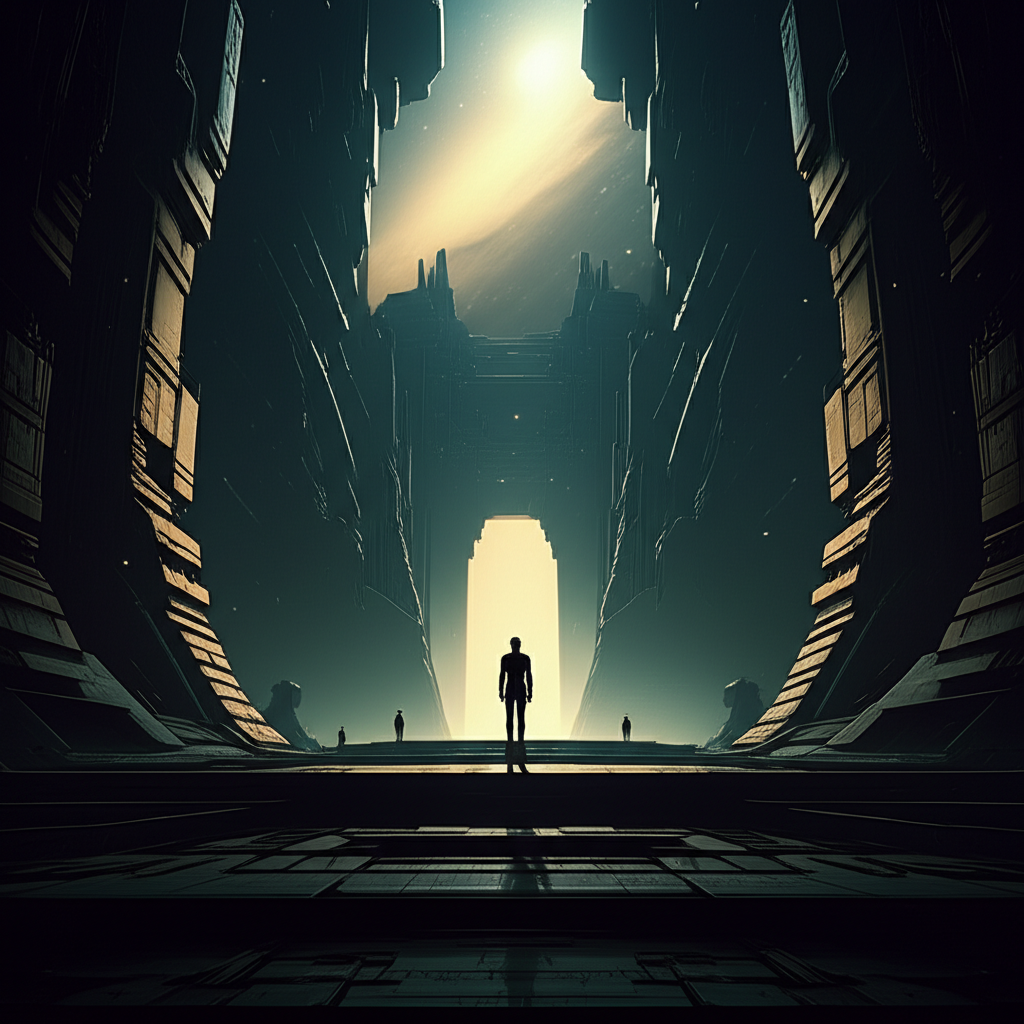
Cosmic Shifts: The Cyclopean Silence
The wind, a ceaseless sculptor of the Antarctic wastes, was the first thing Dr. Elias Thorne expected. Its mournful howls, the sandpaper rasp of ice crystals against his sled, the distant creak of shifting glaciers – these were the symphonies of desolation he had come to anticipate, even rely upon, in his pursuit of geomantic anomalies. But here, at Site 734, there was none of it. Just an impossible, profound emptiness in the air. A silence so absolute it felt less like an absence of sound and more like a conscious, suffocating presence. This was not the quiet of desolation; it was the quiet of profound, unnatural suppression.
Elias, a xenolinguist with a specialization in ultra-low frequency geological harmonics, had been dispatched by the international consortium “Sentinel Prime” – a shadowy organization dedicated to monitoring Earth’s unexplainable phenomena – to investigate a seismic null zone. Satellite data revealed a perfectly circular region, roughly five kilometers in diameter, where all seismic activity, all natural vibrations, all electromagnetic resonance simply… ceased. Now, standing on its threshold, the digital hum of his equipment, the crunch of his boots on the packed snow, even the beat of his own heart seemed to evaporate the moment he stepped over the invisible boundary. It was an immediate, dizzying sensation, like stepping into a vacuum or suddenly losing a sense. The world snapped shut around him, plunging him into a reality where sound simply did not exist.
His team – two geologists, a linguist, and a seasoned survival expert – had suffered various psychological breakdowns within days of establishing camp on the perimeter. The survival expert, a stoic woman named Anya, had begun screaming soundlessly into the void, convinced the silence was chewing her words before they left her lips. The linguist, Dr. Aris Valos, a man of meticulous logic, had withdrawn into catatonia, whispering about “the inverse murmur.” Elias, however, found himself drawn deeper into its oppressive embrace, a perverse curiosity warring with a primal sense of dread. He was the last fully functional member, his obsession with the unheard now a terrifying reality. He knew, with a certainty that chilled him to the core, that whatever lay at the heart of this impossible void, it pulsed with a profound and ancient cosmic horror.
The Heart of the Mute Zone
Two more days of meticulous, soundless trekking brought Elias to the epicenter. The navigational readouts on his wrist-mounted console, usually chirping with satellite pings and environmental data, showed only flat lines. Yet, the magnetic north still held, guiding him with an unseen hand. The snowscape here was subtly different, too. Instead of the familiar wind-sculpted drifts, the snow lay in an unnatural, undisturbed blanket, as if air currents themselves had forgotten how to stir it. The cold, usually a biting knife in the lungs, here felt like a heavy, velvet cloak designed to muffle.
And then he saw it.
Rising from the ice, less a structure and more a geological impossibility, was a vast, obsidian-black monolith. It wasn’t merely large; it was immense, dwarfing the surrounding mountains, its upper reaches lost in the perpetual Antarctic twilight. Its surfaces were smooth, featureless, yet absorbed all light, making it seem like a tear in the fabric of reality, a patch of pure nothingness carved out and dropped onto the world. The edges were too sharp for natural rock, the sheer scale too uniform for geological formation. This was artificial, undeniably so, but built to a proportion that screamed of a non-human genesis. It was, in the most literal and terrifying sense, cyclopean.
Elias stared, his breath frosting in the unnaturally still air, though he couldn’t hear it. His eyes traced the impossible angles, the sheer faces that seemed to defy perspective. There were no visible entryways, no discernible features, just an unbroken expanse of polished black stone that seemed to drink the very light and warmth from the air. He activated his high-res sonar, typically used for subsurface mapping. The results were immediate, and profoundly unsettling. The sonar waves, instead of bouncing back, simply disappeared upon contact with the monolith. It was a perfect absorber, not just of sound, but of all vibrational energy he could produce. It was the physical manifestation of the silence.
He realized then that this monolith wasn’t just in the mute zone; it was the mute zone. It wasn’t radiating silence; it was its very essence. A terrible thought began to coalesce in his mind: could the monolith be a colossal instrument? Or perhaps, an entity existing in a state of perpetual, absolute quiet, its very presence nullifying all sound around it? The sheer audacity of such an idea made him shiver despite the thermal suit. This wasn’t just ancient; it was alien beyond comprehension, a relic of a time before human consciousness, before sound itself held meaning. It was an artifact of pure, unadulterated cosmic horror.
Whispers of Nullity

Days bled into a terrifying, soundless continuum within the shadow of the monolith. Elias established a tiny, insulated camp at its base, drilling anchor points into the intractable rock that seemed to resist even his diamond-tipped drills with eerie resilience. He meticulously scanned every inch of the structure with every sensor array he possessed. Magnetometers showed impossible readings, gravitational fluctuations hinted at impossible densities, and energy meters registered a massive, inert power source unlike anything known to science. All this data was communicated silently, visually, to his console, each graph and numerical sequence screaming of the unnatural.
He began to see patterns. Not on the surface of the monolith – still featureless and blank – but in the way the light played across its angles, the subtle distortion of distant ice formations when viewed through its periphery. It was as if the monolith was subtly bending reality around it. More disturbingly, he started to perceive faint… impressions in his mind. Not sounds, but the memory of sound. Echoes of things that were never heard yet felt deeply. A pressure in his ears, a ghost of a hum beneath his skin, the phantom sensation of air rushing past. The silence was not merely external; it was burrowing inward, rewriting his sensory perception.
He found himself running his gloved hands over the smooth, cold surface, desperate for any tactile hint of its origin or purpose. The stone was impossibly smooth, resisting the minute imperfections that characterized even the most polished natural rock. It felt dead, inert, yet undeniably there. One afternoon, as the sun dipped low, casting long, stark shadows, Elias inadvertently brushed against a slight indentation, almost imperceptible to the naked eye. It wasn’t a crack or a seam, but a shallow, perfectly geometric depression, barely an inch long. He traced it again. And then another, further along the base. And another.
They were everywhere, scattered randomly across the base of the monolith, each an identical, minute glyph. He began meticulously cataloging them, using a laser grid to map their exact positions and orientations. This was the alien language he sought, a visual lexicon where sound had no place. The glyphs were not pictograms, nor did they resemble any known terrestrial or hypothetical extraterrestrial script. They were more like mathematical symbols or the abstract notations of an impossibly complex musical score that existed beyond human comprehension. He wondered if they were meant to be read, or felt, or simply observed.
As he charted more of these minuscule marks, a horrifying realization began to dawn. The glyphs weren’t static. They moved. Imperceptibly, glacially slowly, but they shifted position, disappearing and reappearing, migrating across the vast, featureless surface as if the entire structure were breathing the slowest, most profound breath imaginable. He almost laughed, a soundless, desperate gasp catching in his throat. The monolith wasn’t merely cyclopean; it was alive. And its language was a dance of infinite, silent permutations across its unfathomable surface. This was not merely the work of an ancient race; this was an ancient race itself, or a tool so vast and alien it transcended inert matter. The profound implications twisted his perception of reality, plunging him deeper into the abyss of cosmic horror.
The Architecture of Dread
The realization that the monolith was dynamic, not static, shattered whatever remaining scientific detachment Elias possessed. He was no longer observing; he was interacting, however passively, with something that defied every known law of physics and biology. He spent what felt like weeks, but might have been days—time, deprived of the tick-tock of sound, had become an elastic, unreliable thing—documenting the glacial migration of the glyphs. Each shift, however minute, sent a jolt of primal terror through him. What was this colossal mechanism doing? What was its purpose?
The glyphs, as they moved, began to form fleeting, elaborate patterns, never repeating, always dissolving. He tried to predict their movements, to find a logic, but there was none. Or rather, the logic was so far beyond human comprehension that it appeared as pure randomness. His mind, already strained by the perpetual silence and extreme isolation, began to fracture. He started seeing the glyphs even when he looked away, their faint impressions burned onto his retina, superimposing themselves onto the featureless ice, onto the barren sky.
Then came the dreams. Or were they dreams? They were not images, not narratives, but pure sensations of scale. He would ‘see’ the monolith from impossible distances, receding into a star-dusted void, a minuscule shard in a vast, cold darkness. He would perceive its hidden depths, its core, a churning vortex of geometries that defied Euclidean space, a non-Euclidean engine pulsing with an unfathomable energy. He understood, without understanding how, that its true bulk extended far beneath the ice, perhaps through the Earth’s very core, anchoring it to something ancient and dormant. This was not mere construction; this was an extension of something vast, something that had always been, and would always be. This was the ultimate expression of cyclopean architecture – not just massive, but fundamentally alien to physical space.
He felt the growing psychic pressure, a sensation not unlike water weighing down upon him, but emanating from the glyphs. It was a communication, not of words, but of states. He experienced flashes of unimaginable cold, of immense pressure, of stellar distances, of aeons of time stretching endlessly. He began to suspect that the glyphs were not simply information carriers, but sensors, receptors. Perhaps the monolith was not merely dormant, but listening. And what it was listening for, what it was waiting for, terrified him beyond measure.
One morning, he woke to find a new development. A series of the minuscule glyphs had coalesced along a perfectly vertical line, forming a sequence of symbols that, for the first time, held a semblance of order. He analyzed them with a frantic intensity, comparing them to abstract mathematical concepts, to patterns in nature that resonated with deep cosmic structures. And then, he saw it. The sequence, when interpreted through a complex, speculative xenogrammatical algorithm he had been developing, resolved into something chillingly mundane: Activation Sequence Imminent.
The air, already devoid of sound, seemed to grow even heavier, thicker, as if the very atoms were holding their breath. The dread that had been a slow, creeping vine now blossomed into a full-blown, suffocating presence. The silence intensified, becoming a physical pain behind his eyes, a throbbing void in his skull. He knew
Leave a Reply