
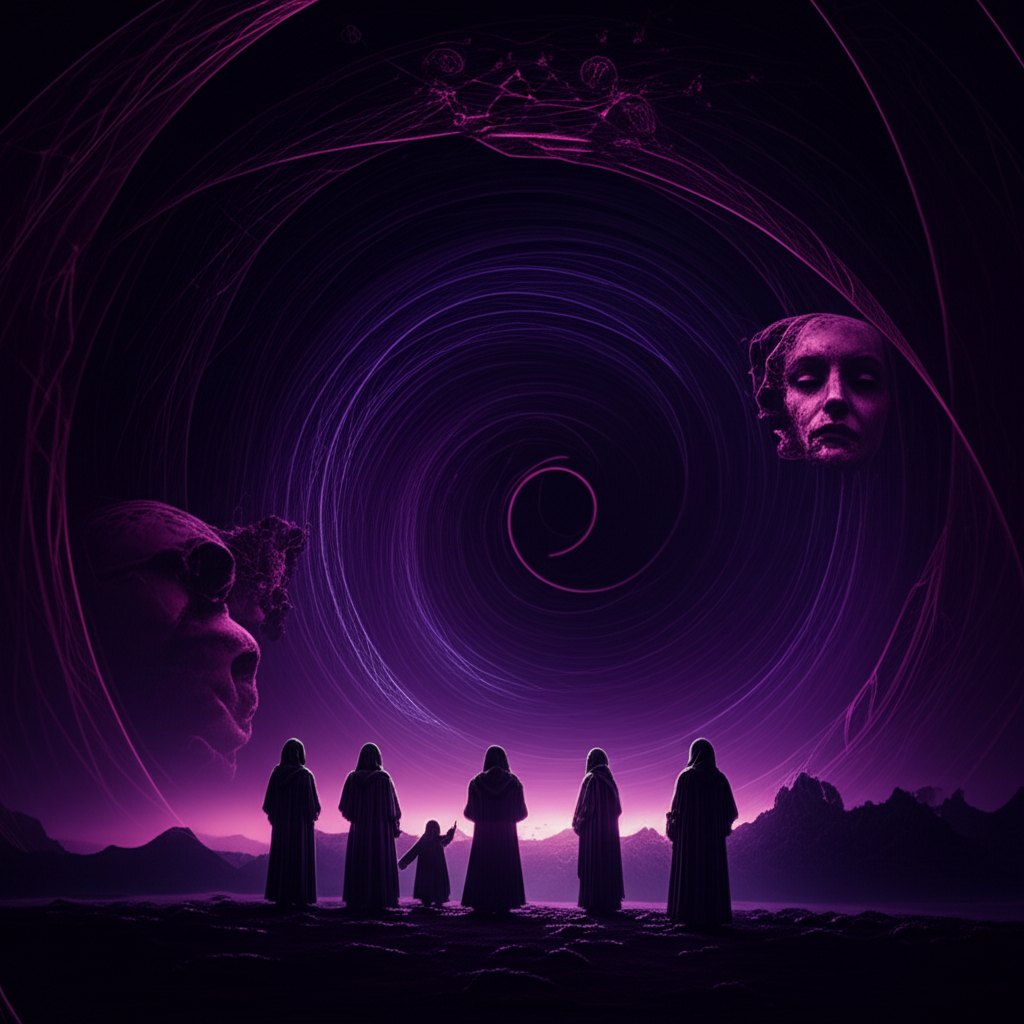
Eldritch Void Dreams: Cosmic Cult’s Maddening Descent
Dr. Alistair Finch considered himself a custodian of the unseen, a cartographer of the forgotten corners of human intellect. His life had been a meticulously cataloged journey through dusty archives and decaying libraries, seeking the obscure, the overlooked, the threads of knowledge history had tried to snip away. It was this singular focus that led him, entirely unprepared, into the gaping maw of the incomprehensible, to the precipice of a truth that devoured sanity whole.
The object of his burgeoning obsession began innocently enough: a consignment of esoteric texts from the estate of the late Professor Silas Blackwood, a reclusive antiquarian whose reputation for eccentricity overshadowed any scholarly contributions. Among the mildewed volumes on alchemy and discredited philosophies lay a single, unbound codex, its pages of vellum yellowed and brittle, covered in a script Alistair had never encountered. It was clearly ancient, predating any known linguistic family, yet it possessed a chillingly organic quality, the symbols seeming to writhe and coil under his gaze like microscopic serpents.
Alistair spent weeks, then months, hunched over the manuscript in his dimly lit study, the scent of old paper and dust clinging to him like a shroud. The more he studied, the more the bizarre script seemed to imprint itself upon his mind, weaving into his waking thoughts and, more disturbingly, his dreams. These were not the usual chaotic jumble of subconscious processing; these were Eldritch Void Dreams. He would float in an endless, starless abyss, pursued by silent, colossal forms that moved with an alien geometry, their presence a pressure on his very soul. He’d wake in a cold sweat, his heart hammering, an ineffable dread clutching at his throat, the metallic taste of fear coating his tongue.
The manuscript, which he tentatively named the Chronicon Umbralis, whispered of things that defied common sense, of entities that pre-dated the stars, of a universe vast and indifferent, populated by forces far beyond humanity’s gentle imaginings. It spoke of a place, a coastal settlement named Oakhaven, where the veil between worlds was thin, and where an ancient cult maintained a vigil, performing rituals under alien constellations. He initially dismissed it as elaborate fiction, a wonderfully complex but ultimately harmless exercise in dark fantasy. But the dreams persisted, growing more vivid, more insistent. The symbols from the Chronicon began to appear in his waking life: patterns in frosted windowpanes, shadows cast by lamplight, the swirling foam of his morning coffee. The world around him started to feel subtly off-kilter, a stage set for a drama he was only just beginning to comprehend. The call of Oakhaven became an undeniable whisper, a siren song promising answers, or perhaps, oblivion. He packed a single bag, the Chronicon Umbralis nestled within, and set course for the forgotten coast, oblivious to the terrifying truth awaiting him, oblivious to the fact that he was already entangled in a web of forbidden knowledge and ancient, monstrous intent.
The Whispers of the Unseen Scroll
The journey to Oakhaven was a descent into increasing isolation, a slow peeling away of the familiar world. Alistair’s antique sedan hummed along forgotten roads, the landscape transforming from manicured fields to gnarly, wind-battered trees and eventually, a desolate expanse of salt-crusted earth. The air grew heavy, thick with the scent of brine and something else—something ancient and unwholesome, like damp decay mixed with ozone. The sky, usually a vibrant tapestry of blue, was perpetually overcast, a bruised, gunmetal grey that pressed down on the narrow ribbon of asphalt.
He had spent months deciphering fragments of the Chronicon Umbralis, enough to pinpoint Oakhaven as the likely locus of its dark pronouncements. The text, initially a mere academic puzzle, had become an insidious companion, its forbidden symbols tattooing themselves onto the inside of his eyelids. It wasn’t merely a language; it was a key, each translated passage unlocking a new chamber in the mansion of his subconscious, where unsettling truths lay coiled like sleeping vipers. He learned of a primordial ocean, not of water and currents, but of thought and raw, formless energy, teeming with awarenesses so vast they rendered mortal consciousness a fleeting spark. He learned of a Great Sleeper, an entity that drifted through this cosmic medium, its dreams occasionally rippling the fabric of reality, creating paradoxes and horrors on planes beyond human grasp.
One particularly disturbing passage spoke of a “Doorway of Salt and Shadow,” guarded by those who had tasted the void and found it nourishing. This was, he suspected, the cult referred to in the title of this dread chronicle. He’d dismissed it as poetic metaphor until his dreams intensified, showing him glimpses of bizarre architecture, structures that seemed to defy earthly physics, rising from the churning grey sea, their sharp angles cutting impossible silhouettes against a sky lit by phantom auroras.
His research had initially been met with amused skepticism by his colleagues. Dr. Eleanor Vance, his closest friend and a respected folklorist, had laughed off his claims of undecipherable languages and unsettling dreams as the natural consequence of too much caffeine and too little sunlight. “Alistair,” she’d chided gently, “you’re staring at patterns where there are none. The human mind is wired to find meaning, even in static.” But Alistair knew, with a certainty that chilled him to the bone, that this was no static. This was a signal, clear and horrifying, broadcast from beyond the stars.
The Chronicon was not a book, but a prophecy, a guide, and a warning. It chronicled the history of a chosen lineage, a “cosmic horror cult” devoted to the Great Sleeper. They believed the entity was not malevolent, but simply was, and that humanity’s suffering stemmed from its ignorance of the true nature of existence. Their rituals, according to the text, were not for power or personal gain, but to commune with the cosmic mind, to understand its vast, uncaring purpose, and ultimately, to join it. The ultimate goal was to transcend mortal consciousness, to shed the illusion of individuality and merge with the universal consciousness of the Great Sleeper. The cost, the Chronicon hinted darkly, was sanity. And perhaps, humanity itself.
Every mile closer to Oakhaven felt like a step into a deeper layer of dream. The air grew colder, the light grew dimmer, and the silence stretched, broken only by the mournful cry of unseen gulls and the relentless roar of the distant surf. The GPS on his phone had failed hours ago, replaced by a flickering “No Signal” message that somehow intensified his feeling of being cut off, adrift. He found himself relying on a painstakingly drawn map from the Chronicon, a crude, diagrammatic sketch that depicted Oakhaven not as a town, but as a series of concentric circles radiating from a central point marked only by an eye-like symbol. The map, he realized with a shiver, looked less like a geographical guide and more like a ritualistic diagram.
As the sun, a pale, watery disc behind the clouds, began its slow descent, he saw it: a cluster of buildings huddled against the relentless assault of the sea, their roofs black with age, their windows like vacant eyes staring out at the turbulent waves. Oakhaven. It stood sentinel on a rocky promontory, a monument to forgotten time and untold secrets. The road ended abruptly at the town’s entrance, dissolving into a gravel path that wound between decaying, salt-blasted houses. There were no welcoming lights, no children’s laughter, no sign of life beyond the faint, rhythmic clang of a distant buoy bell. It was as if the town itself held its breath, waiting. For him.
Ashen Shores and Watchful Eyes

Alistair parked his car by the derelict remains of what might have once been a general store, its windows boarded up, its sign swinging precariously in the wind. The silence here was profound, broken only by the ceaseless roar of the ocean and the occasional shriek of a gull. The air tasted of salt, damp stone, and something acrid, almost metallic.
The town itself was a testament to decay. Houses leaned against each other as if for support, their paint long since scoured away by the relentless coastal winds, exposing the grey, rotting wood beneath. Nets hung like tattered shrouds from sagging porches, and the skeletal remains of forgotten fishing boats lay beached on the gritty shoreline. There were no lights in the windows, no smoke curling from chimneys, yet Alistair felt an undeniable prickle of awareness, a sensation of being watched.
He walked the narrow, winding lanes, the gravel crunching under his shoes, the sound amplified in the oppressive quiet. A sudden movement caught his eye: a figure emerging from the shadow of a particularly leaning house. It was an old woman, her face a roadmap of wrinkles, her eyes a startling, pale blue that seemed to hold the cold depth of the ocean. She wore a simple, dark dress and carried a basket woven from dried reeds. She didn’t speak, but her gaze was direct, unnervingly knowing.
“Good evening,” Alistair ventured, his voice sounding ridiculously loud in the hush. “I’m looking for lodgings. Is there an inn or a guesthouse here?”
The old woman tilted her head, a slow, deliberate movement that made the sparse grey hairs escaping her bun shimmer. A hint of a smile, like a ripple on still water, touched her lips. “Newcomers are rare in Oakhaven, Doctor. But not unwelcome. Not if they bear the mark of the seeker.” Her voice was a dry whisper, like rustling leaves, yet it carried an odd resonance, as if she spoke from a great distance.
Alistair felt a jolt of alarm. “How did you know I was a doctor?”
“We know what the tide brings,” she replied, her gaze drifting briefly to the Chronicon nestled in Alistair’s satchel, hidden beneath his coat. His blood ran cold. He hadn’t revealed its presence to anyone. “You seek answers, do you not? Answers to questions that should remain coiled in the dark?”
Alistair found himself unable to lie. The truth felt inevitable here, like the incoming tide. “Yes. I’ve been studying ancient texts… a specific manuscript led me here.”
“The Chronicon Umbralis,” she stated, not a question but a confirmation. “It calls to those with open minds, and open spirits. Come, follow me. Our hospitality is simple, but our truths are vast.”
She turned and began to walk deeper into the tangled heart of Oakhaven, her small, bent figure moving with a surprising agility. Alistair, despite a rising tide of unease, found himself following, drawn by an invisible current. His rational mind screamed for caution, but a deeper, more primal part of him, stirred by the forbidden knowledge he’d consumed, urged him onward.
She led him to a sturdy, if weathered, stone house overlooking the sea. Inside, it was sparsely but meticulously kept. A fire crackled invitingly in a hearth, casting dancing shadows on rough-hewn beams. The air had a faint, herbal scent, mingled with the ubiquitous smell of salt and decay.
“
Leave a Reply