
Ghostly Curtain’s Unfinished Pact
The air in Elias Thorne’s restoration studio always carried the scent of old wood, linseed oil, and forgotten histories. It was a comforting aroma to him, a testament to the lives lived and craftsmanship honed. Elias, with his wire-rimmed spectacles perched on a diligent nose, was a meticulous man, one who found solace in the careful resurrection of antique furniture, decaying tapestries, and faded artworks. He believed every object held a story, a whisper of its past, but none had ever screamed like the one that arrived on a particularly blustery autumn evening.
It was a curtain, massive and imposing, delivered haphazardly in a moth-eaten canvas sack stamped ‘Property of Blackwood Manor – Deceased Estate.’ The estate agent, a nervous woman with perpetually damp hands, had offered little information beyond a vague tale of a century-old house swallowed by neglect. Elias’s initial assessment revealed a fabric of such dark, heavy velvet it seemed to absorb light rather than reflect it. It possessed an almost obsidian quality, interwoven with threads of tarnished gold depicting an intricate, repeating pattern of interwoven hands and stylized thorns. The opulence was undeniable, yet it was ravaged by time—rips like weeping wounds, the velvet nap crushed in places, and a pervasive aroma that was neither dust nor mildew, but something else entirely: a faint, metallic tang, like old blood mixed with dried roses.
As he carefully unfurled it across his largest workbench, an inexplicable chill permeated the studio, a cold that seeped not from the cracks in the old building, but from the very fabric of the curtain itself. He traced a finger along one of the intricate, gold-threaded hands, feeling a prickle of unease. There was something profoundly unfinished about the design, a sense of truncation, as if the pattern abruptly ceased, leaving the story untold. He shook his head, attributing it to a long day and the unusual nature of the piece. This was merely an object, albeit a very old, very damaged one. He began the slow, delicate process of documenting its condition, unaware that he was not merely restoring fabric, but awakening a long-dormant presence, and stepping into the chilling shadow of a ghostly pact.
The Loom of Forgotten Secrets
The curtain dominated the studio. Its sheer size and density made it an anchor in the room, drawing Elias’s gaze even when he tried to focus on other projects. He set up specialized lighting to examine the intricacies of its embroidery, revealing more of the opulent, disturbing pattern. Those repeating hands, he realized, weren’t simply intertwined; they seemed to be reaching, grasping, almost pleading. And the thorns weren’t just decorative; they appeared to pierce the hands, drawing invisible blood. The motif intensified a growing sense of disquiet, a feeling that this curtain was more than just a historical artifact – it was a historical record, woven with a terrible memory.
His work, usually a soothing rhythm of meticulous detail, became fraught with unsettling incidents. Tools would vanish from his well-ordered bench, only to reappear in plain sight, a few inches from where he’d last placed them. The studio’s old clock, usually reliable, began to chime erratically, sometimes striking thirteen, sometimes failing to chime at all. One afternoon, while carefully cleaning a section of the velvet with a delicate brush, Elias felt a distinct, icy pressure against his hand, as if a fingers long and cold had brushed his own. He snatched his hand back, heart hammering, but the studio was empty, silent save for the hum of the dehumidifier.
He rationalized it. Stress, fatigue, an overactive imagination, perhaps the old building settling. Yet, the incidents continued to escalate. He started to catch fleeting glimpses in his periphery—a shimmer of movement where there should be none, a shadow too deep, too defined, behind the heavy folds of the curtain. Once, he swore he heard a faint sigh, like the last breath of a dying wind, emanating from the deep folds of the velvet. It carried a hint of that familiar, metallic-rose scent. His rational mind, however, fought valiantly against the encroaching dread. He told himself he was merely assigning significance to random occurrences, projecting his own weariness onto inanimate objects. But deep down, a primal alarm was beginning to sound. The unfinished look of the embroidery started to gnaw at him, a symbol of something more profound than a mere design flaw. He couldn’t shake the feeling that the curtain itself was not just observing him, but waiting. Waiting for him to continue, to finish something that had been left undone for a very long time.
Whispers Behind the Velvet Veil

The nights became the worst. Elias, a creature of habit, often worked late, the silence of the studio broken only by his own movements and the distant city hum. But with the curtain there, the silence felt heavier, pregnant with unspoken things. He found himself avoiding looking directly at it, glancing only out of the corner of his eye, hoping to catch whatever it was that seemed to move within its shadows.
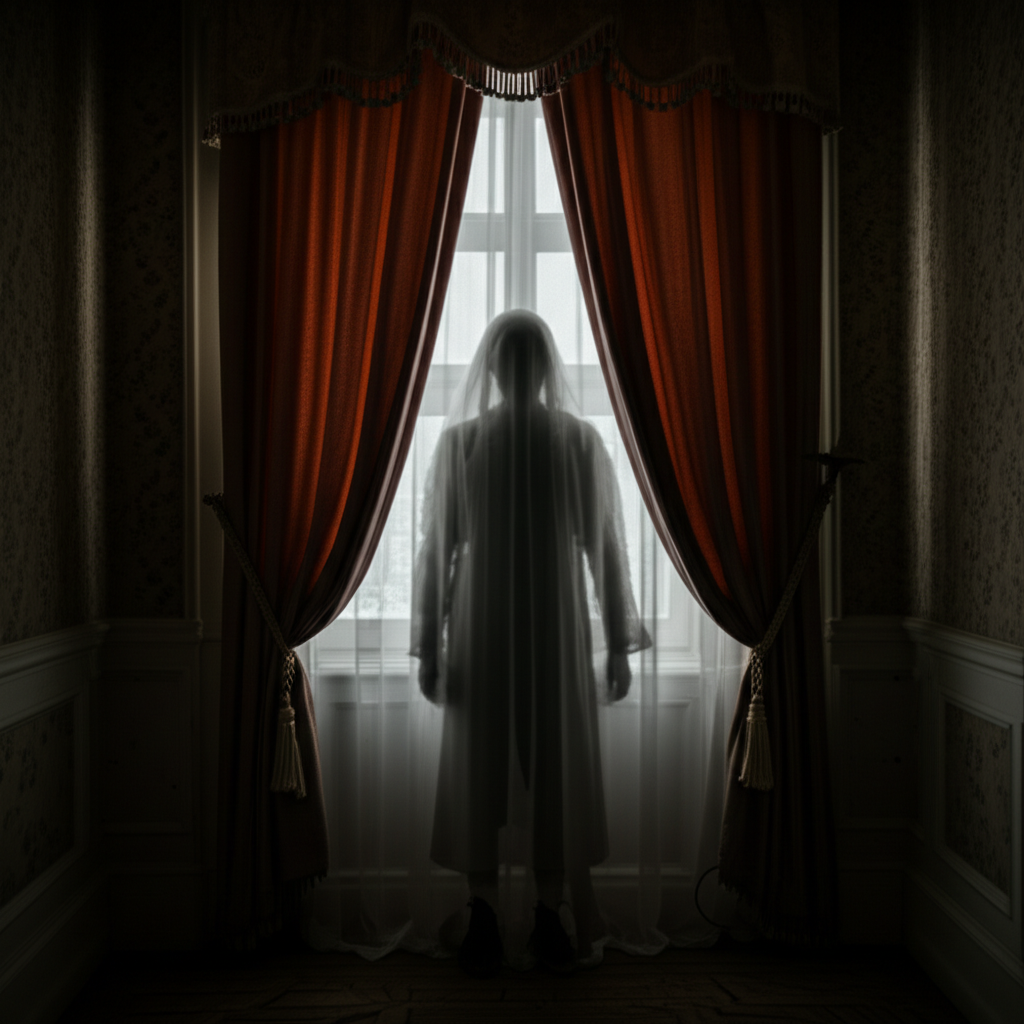
One evening, while meticulously reinforcing a torn seam, he felt it again—a profound drop in temperature directly behind him. The hairs on his arms stood on end. He slowly turned, his breath catching in his throat. Suspended just behind the curtain, a form coalesced from the deeper shadows. It was indistinct, shimmering like heat haze, but unmistakably humanoid. Its outline flowed and shifted, a vague impression of a slender figure shrouded in cascading fabrics, though no details were visible. A faint, desperate groan, barely audible, seemed to emanate not from the air, but from the very fabric of the massive velvet panel. The metallic-rose scent intensified, sickeningly sweet.
Elias, despite his terror, stood transfixed. A primal fear rooted him to the spot. He couldn’t scream, couldn’t move. The apparition didn’t advance, didn’t threaten, but simply existed, an ephemeral silhouette behind the dark velvet. There was an immense sadness, an almost unbearable weight of grief that radiated from it, pressing down on Elias. Then, as quickly as it had appeared, the form dissipated, dissolving back into the preternatural gloom from which it had come, leaving only the oppressive weight of the cold and the heavy scent of the old roses.
He fled the studio that night, leaving lights blazing, the curtain still unfurled, a silent, menacing presence. He spent a sleepless night, plagued by fleeting images of those grasping, thorn-pierced hands, and the pervasive sense of an unfinished task. The logical explanations he usually constructed crumbled under the weight of the inexplicable. This wasn’t fatigue; this was a manifestation. A ghost. A presence bound to the fabric, the Blackwood Manor, and whatever dark history it embodied. The curtain was not merely a textile; it was a shroud, a window, a barrier, and perhaps, a prison. He knew then that he couldn’t ignore it, couldn’t send it back. The ghost had reached out, and he had been chosen to hear its plea.
The Echoes of a Broken Vow
Determined to understand, Elias started researching Blackwood Manor. Online archives yielded little – simply an old, wealthy family line that had abruptly dwindled in the early 20th century. Local historical societies, however, proved more fruitful. He dug through dusty ledgers and brittle newspapers, tracing the manor’s lineage. His search eventually led him to the story of Lady Eleanor Blackwood, the last true resident of the manor, who disappeared without a trace in 1918. Her sudden vanishing, just as the Great War ended, was scandalous at the time, but the local authorities eventually concluded she had simply run off. No body was ever found. No clues. Just the empty manor, slowly decaying.
Elias felt a chill as he read a faded article detailing Lady Eleanor’s beauty and her passionate, but ill-fated, romance with a young officer named Captain Thomas Finch. Finch, celebrated for his bravery, was killed in the final days of the war. But there was a cryptic mention in Eleanor’s personal diaries (which Elias managed to find through a distant relative’s auction catalogue): “Our pact, sealed in velvet and moonlight, will bind us eternally, even in death. My love, promise me you’ll finish.”
“Finish what?” Elias muttered aloud, his gaze drawn to the intricate pattern of intertwining hands on the curtain back in his studio. The thorns, he now saw, symbolized not just love (roses), but pain, sacrifice, perhaps a wound. The pattern was a covenant, a promise. But one half of the design, one half of the woven hands, seemed more frayed, less complete than the other, perpetually hinting at something neglected, something deliberately left unfinished. It was an emblem of the broken vow, the unfulfilled promise, the unfinished pact.
He returned to the studio with these revelations, a new understanding settling like a shroud over his thoughts. The ghost of Lady Eleanor, perhaps, unable to rest, forever awaiting the conclusion of this sacred vow. The curtain wasn’t just a possession; it was the sacred object of their union, the very fabric upon which their love, and ultimately their tragedy, was woven. It dawned on him that the metallic-rose scent wasn’t just old blood and dried flowers; it was the essence of a love both fervent and fatal, a life cut short, and a promise that had been violently severed. The curtain was a testament to a love that sought to transcend boundaries, yet became a prison within which the spectral echo of Lady Eleanor now resided.
That night, Elias stayed late, no longer afraid in the same panicked way, but filled with a profound empathy and a growing sense of responsibility. He felt the weight of her unfinished story, a century of yearning. He looked at the curtain, now dimly lit by the single lamp above his workbench. He saw the shimmering form behind it again, clearer this time. It was Lady Eleanor, her face a blur of sorrow, her delicate hands reaching out, almost touching the embroidered hands on the velvet itself. The sorrow emanating from the ghost was a palpable thing, a wave of despair that brought tears to Elias’s eyes, even as he shivered. Her lips moved, though no sound escaped, yet he heard, as if in his own mind, a single, repeated word: “Finish… finish…”
The pact. He had to understand what it entailed.
Entangled in the Spectral Weave
Elias delved back into the diaries. Amidst declarations of love and wistful anecdotes, he found it: a detailed account of a hidden compartment beneath the grand oak fireplace in Blackwood Manor’s master bedroom. Inside, Eleanor wrote, lay a small, velvet-bound journal containing “the truth of my inheritance, the injustices perpetrated by my avaricious cousin, Alistair, and the details of how Thomas and I would use it to right those wrongs and carve out a new life. Our ‘pact’ was to ensure justice and freedom for all those Alistair had exploited, and to create a legacy of kindness, not greed. This journal, my love, must be revealed.”
Her words painted a clearer picture. It wasn’t just a romantic pact; it was a pact of justice, of righting wrongs. Her cousin, fearing exposure, must have orchestrated her disappearance, ensuring the journal and its truths remained hidden, and the inheritance fell to him. Thomas’s death had left the pact unfinished, the ghost of Eleanor trapped, unable to rest until her truth was revealed and her family’s legacy restored. The curtain, intended as a symbol of their unity and their future home, became instead a witness to her betrayal and a tether for her restless spirit.
With a new, terrifying purpose, Elias contacted the current owners of Blackwood Manor. They proved reluctant, seeing him as a strange antiquarian chasing shadows. It took all of his persuasive skills, and a substantial sum of money, to convince them to grant him access to the master bedroom for a single afternoon.
The manor was a ruin, a skeleton of its former grandeur. Dust motes danced in the slivers of weak sunlight filtering through grime-streaked windows. The master bedroom was a vast, cold chamber, dominated by a towering, intricately carved oak fireplace. Elias felt the immediate drop in temperature, the tell-tale sign of Eleanor’s presence. The metallic-rose scent was overwhelming here, as if centuries of her sorrow had imbued the very walls. He felt her impatience, her desperate hope.
Working quickly, he located a loose stone panel beneath the mantelpiece, just as Eleanor’s journal described. He pried it open with a trembling hand, revealing a shallow, cobweb-laden cavity. Inside, wrapped in a brittle silk scarf, was the small, velvet-bound journal. The edges of the book felt strangely warm in his grasp.
Just as he secured the journal, a gust of wind, though all windows were closed, slammed the heavy bedroom door shut
Leave a Reply