
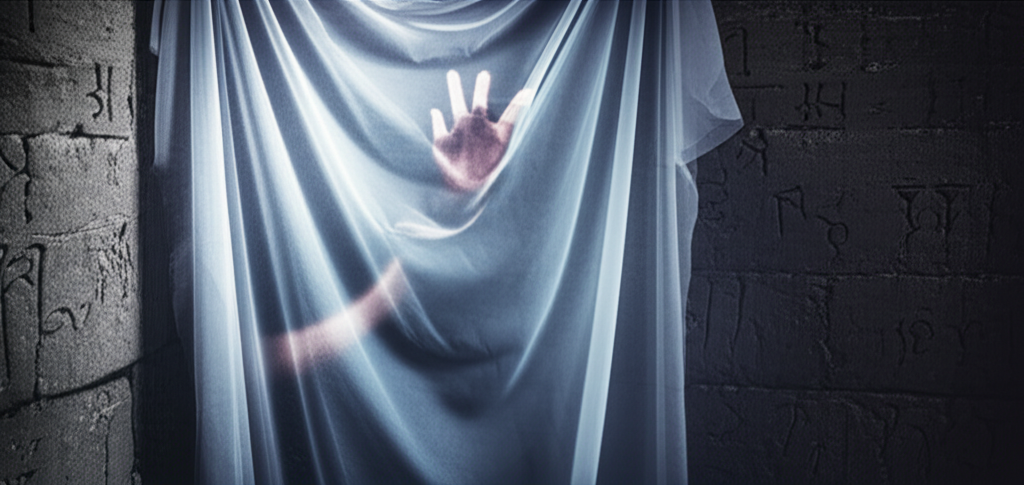
Harrowing Veil: Ancient Touch of the Supernatural
The sea, a brooding slate under a sky bruised purple, churned relentlessly against the jagged cliffs of the forgotten coast. It was here, where the world fractured into desolate beauty and chilling legend, that Dr. Elias Thorne finally found it. Not merely a ruin, but a scar on the very fabric of time – the so-called ‘Ossuary of Whispering Stones.’ Local folklore, gleaned from hushed conversations with the few fishermen hardy enough to brave the perpetually grey waters, spoke of an unnatural stillness that clung to the place, of shadows that moved with an intelligence not their own, and a frigid touch that stole the warmth from the living. Elias, a man whose life had been dedicated to unearthing the suppressed whispers of history, dismissed the supernatural tales as poetic embellishments. He sought only the tangible truth, the archaeological record of a civilization so profoundly ancient it predated written language, stretching back into humanity’s primal genesis. He was a rationalist, armed with trowels and carbon-dating kits, ready to peel back layers of earth, not veils of spectral dread. Yet, even as his boots crunched on the salt-sprayed shingle, a prickle of unease snaked up his spine, a premonition that perhaps, just perhaps, some truths were not meant to be exhumed. This place, cloaked in mist and myth, felt less like a discovery and more like an awakening.
The Ossuary of Whispering Stones
The expedition had been a passion project, funded by a wealthy, eccentric patron with an interest in esoteric history. Elias, alongside his sharp-witted protégé, Dr. Anya Sharma, and their grizzled local guide, Ronan, established a rudimentary camp amongst the weathered boulders a safe distance from the site. The Ossuary itself lay partially submerged, a monolithic structure of dark, unidentifiable stone rising from the surf like the petrified ribs of some antediluvian beast. It was unlike any known architecture, angular yet organic, with surfaces that seemed to absorb light rather than reflect it.
Their first foray into the site revealed a network of subterranean chambers, accessible only at low tide. The air within was thick with the scent of damp earth and something else—a faint, metallic tang, like old blood or ozone, that made the hairs on Elias’s arms stand on end. Anya, ever the pragmatist, attributed it to geothermal activity or unusual mineral deposits. Ronan, however, simply shivered. “Not a good place,” he’d muttered, his eyes wide, fixed on a particularly dark corner where the shadows seemed to writhe.
The stones, as the locals called them, were remarkable. They pulsed with an eerie coolness to the touch, even in the muggy atmosphere. Intricate, non-repeating ideograms, unlike any script Elias had ever seen, covered every surface. They didn’t appear carved; rather, they seemed inherent to the stone itself, as if the very rock bled meaning. “It’s pre-Atlantean,” Anya breathed, her awe overcoming her usual scientific detachment. “Older than Göbekli Tepe, older than anything we have a record of. What were they?”
They spent days meticulously mapping the accessible chambers. The higher tunnels were dry, leading to what appeared to be ritual spaces. One chamber, in particular, dominated their attention. It was perfectly circular, capped by a vaulted ceiling, at the center of which stood a single, obsidian pillar. Unlike the surrounding stones, this pillar was smooth, almost polished, drawing the eye with its absolute blackness. As Elias approached it, he felt a distinct ripple in the air, a drop in temperature that was far more localized than the general chill. He extended a gloved hand, reaching out to touch its surface.
Before he made contact, a sharp, crystalline image flashed across his mind: a vast, unseeing eye, ancient beyond comprehension, watching from an impossibly distant void. He snatched his hand back, heart hammering. “Did you feel that?” he asked, turning to Anya.
She looked at him curiously. “Feel what, Elias? The drafts?”
He shook his head, brushing away the phantom image. “Nothing. Just… my imagination playing tricks.” But as he spoke the words, a tremor of doubt ran through him. This place was beginning to work its way under his skin. The feeling wasn’t merely one of cold stone and historical significance; it was a burgeoning sense of a pervasive, malevolent presence, a truly supernatural aura that went beyond rational explanation. The Ossuary was not just a ruin; it was a mausoleum of forgotten, terrifying power, brimming with an ancient touch that seemed to reach out through time itself.
Fingers of the Forgotten Past
As their work continued, the subtle disquiet began to intensify. It started with small things. Tools would vanish from their assigned spots, only to reappear later in illogical locations. Equipment would malfunction inexplicably, lights flickering out in the deepest parts of the Ossuary, plunging them into suffocating darkness, broken only by the rhythmic lapping of the tides outside. Each incident, individually, could be explained away – human error, faulty wiring, the corrosive damp. But collectively, they formed a pattern, a slow, deliberate erosion of their scientific certainty.
Anya, usually unflappable, became increasingly irritable. She complained of feeling constantly observed, even when alone. “It’s like something is breathing down my neck,” she grumbled one evening, rubbing her stiff neck. “A cold air that isn’t just a draft.” Elias himself found sleep elusive. Nightmares, vivid and unsettling, plagued him. He dreamt of forms shifting in peripheral vision, of eyes without pupils, and of a ceaseless, sibilant whispering that seemed to emanate from the very bedrock beneath them.
One morning, Ronan refused to enter the central chamber. His face was ashen. “I felt something last night, Doctor,” he told Elias, his voice barely a whisper. “A touch on my cheek, cold as death itself. And then… a voice. Not in my ears, but in my head. It spoke a name. My name. From the darkness.” He crossed himself violently. “This place is cursed. An ancient evil sleeps here, and we’ve woken it.”
Elias, attempting to calm him, reasoned it was sleep paralysis, or the psychological stress of the isolated environment. But Ronan’s fear was palpable, visceral. His conviction disturbed Elias more than he let on.
That afternoon, while retrieving a camera left in the central chamber, Elias experienced something that shattered his remaining skepticism. As he bent to pick up the device, he felt it – a distinct, icy pressure on the back of his exposed neck. It wasn’t just cold; it was alien, possessing a strange, electrostatic quality. He flinched, spinning around, but saw nothing. The chamber was empty save for himself and the obsidian pillar. Yet, the sensation lingered, a phantom imprint on his skin. It felt like a finger, incredibly long and skeletal, had lightly traced his flesh.
He ran a hand over his neck. There was no mark, no bruise. But the memory of that touch was indelible, profoundly unnerving. His heart hammered. This was no draft, no trick of the mind. This was a physical interaction, a manifestation of the supernatural. Was this the ‘whispering stones’ of local myth? Was the ancient touch that Ronan spoke of more than just a chilling breeze?
He spent the rest of the day in a state of heightened anxiety, jumpy at every shadow. That night, examining the obsidian pillar with a portable scanner, he made a discovery. Embedded within the crystalline structure of the stone, invisible to the naked eye, were intricate energy signatures unlike anything he’d ever encountered. They weren’t mineral; they pulsed with a rhythmic, almost biological energy, ancient and utterly alien. The pillar wasn’t merely a monument; it was a conduit, a focal point. And the strange symbols on the walls? They weren’t carvings. They were manifestations of this energy, a language of pure force, subtly shifting and changing when viewed from different angles, almost alive. The ancient touch was everywhere, pervasive, suffocating.
The Mark of the Primal
The Ossuary began to demand its due. Ronan, after another night of terror, packed his bags and, despite Elias’s pleas, simply left, disappearing into the mist of the coastline. “You will be consumed,” he’d warned Elias, his eyes wide with desperate alarm. “It will take you piece by piece. You are already touched by the supernatural.”
Anya, though still present, withdrew into herself, her sharp wit replaced by a brooding silence. She spent hours staring at the ocean, her face pale, an unreadable expression in her eyes. Elias often found her tracing the strange ideograms on the chamber walls with a vacant look, murmuring to herself in a language neither of them understood. When he asked her about it, she would snap at him, her voice suddenly harsh, utterly unlike her usual self. A pall of dread had settled over their camp, thick and suffocating.
Elias, despite the mounting evidence, fought to maintain his scientific objectivity. He immersed himself in the analysis of the symbols. He found patterns, recurring motifs that mirrored primitive representations of life and death, but twisted, perverted. They spoke of consumption, of assimilation, of a boundless hunger. And the touch was everywhere now.
He felt phantom taps on his shoulder, the whisper of air against his scalp when no wind stirred. The cold became a solid presence, an entity that pressed against him in the dark, its formlessness more terrifying than any solid shape. His worst experience came when he attempted to retrieve an artifact from a deep crevice near the obsidian pillar. As he reached into the gap, a sudden, agonizing pain lanced through his hand. He cried out, pulling back instinctively.
On the back of his palm, a mark had appeared. Not a scratch or a bruise, but a perfectly formed symbol, identical to one of the constantly shifting ideograms on the chamber walls. It was etched into his skin, a burning brand that pulsed with a faint, internal light, like a tiny, malevolent star. The ancient touch was no longer merely a feeling or a chill; it was a physical inscription, a claim. He knew, with a certainty that chilled him to the bone, that this was no ordinary mark. It burrowed beneath the skin, a foreign essence now entwined with his own flesh, a literal ancient touch that signified something profound and terrifying.
Anya saw the mark later that night. She didn’t gasp or recoil. Her eyes simply widened, a strange, almost hungry admiration in their depths. She reached out, her fingers brushing the symbol. “Beautiful,” she whispered, her voice husky and strange. “It’s calling to you. The ancient one wants to touch us all.” Elias recoiled from her, terrified. Her sane mind was clearly fracturing under the oppressive weight of the entity.
He realized then the utter scope of their folly. They hadn’t merely discovered an archaeological site; they’d stumbled upon a gaol, a prison for something unspeakably old and malevolent. And by their presence, their prodding, their very curiosity, they had begun to dissolve the seals, allowing an ancient horror to seep back into the world, an entity of pure supernatural intent, whose only connection to this realm was the terrifying, invasive touch it now imparted. The mark on his hand burned anew, a silent testament to the ancient power that had claimed him.
Whispers Through the Veil
Anya’s transformation accelerated. She spent most of her time within the central chamber, muttering to herself in the same incomprehensible language she’d spoken before, her movements becoming stiff,

Leave a Reply