
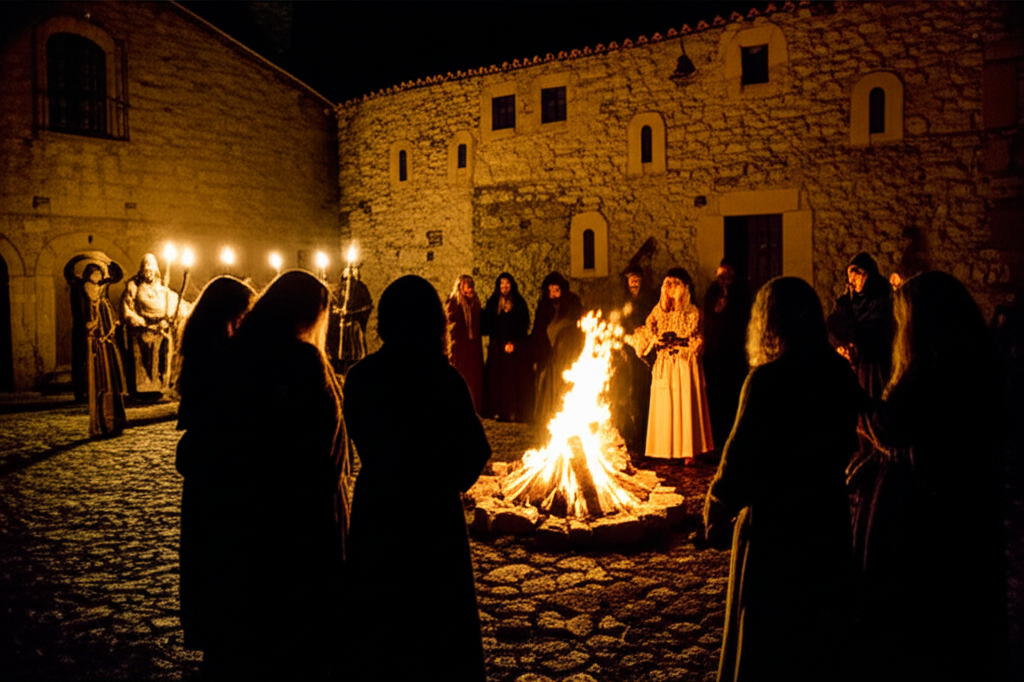
Hearth’s Dread Ritual
The ancient map, brittle with age, bore a curious stain – a dark, irregular blotch near a cluster of faded trees marked “Elder Woods.” It was this anomaly, this almost deliberate blemish on an otherwise meticulously drawn survey, that had first snagged Elias Thorne’s attention. A cartographer’s oversight, or something more? As an archivist and historical cartographer, Elias was drawn to such obscure whispers of the past, to the places civilization had overlooked or actively forgotten. And so, the remote village of Oakhaven, a mere speck on modern maps, became his destination.
His journey began with asphalt roads giving way to crumbling tarmac, then to gravel, and finally, to a muddy track barely wide enough for his sturdy, if aging, sedan. The air thickened with the scent of damp earth and decaying leaves, growing heavier the deeper he drove into the forested valley. Trees, ancient and gnarled, formed a dense canopy overhead, their branches intertwined like gnarled fingers, filtering the late afternoon light into a mosaic of shifting shadows. The silence was profound, broken only by the crunch of tires and the distant, almost imagined caw of a crow. An unsettling introduction, yet one that suited his academic pursuit of archaic harvest practices and forgotten rural cults. This was the kind of isolation that often bred peculiar traditions, the perfect crucible for a hidden folk horror.
Then, through a sudden break in the oppressive woodland, Oakhaven appeared. It wasn’t a sudden burst of pastoral beauty, but rather an emerging presence, nestled in a bowl of low hills that seemed to cup it possessively. A handful of squat, stone cottages, their roofs thatched with straw darkened by ages of weather, clustered around a central green. A single, weathered church spire rose above them, looking less like a beacon of faith and more like a skeletal finger pointing to a perpetually overcast sky. Smoke curled lazily from a few chimneys, painting faint white wisps against the encroaching twilight. It looked idyllic, perhaps, to a casual observer. But to Elias, whose mind was tuned to the frequencies of overlooked history, there was an unnerving quietude, a watchful stillness that permeated the very air of the village. No children played, no dogs barked, no distant agricultural machinery hummed. Just the profound, encompassing silence of a place that held its breath.
As he drove onto the cobblestone path that served as the village‘s main artery, heads turned. Not overtly, not with curiosity or welcome, but subtly. Faces, framed by the dim light filtering from cottage windows, appeared and vanished in quick blinks. Their gazes felt heavy, assessing, and strangely ancient. Elias, despite his academic detachment, felt a prickle of unease crawl up his spine. He was an outsider, an intruder, and Oakhaven, he sensed, did not take kindly to strangers. He consulted the crumpled note in his hand – directions to the cottage he’d rented through a rather archaic phone call: “The Weaver’s Croft, near the old mill stream.” He pressed on, his academic curiosity battling a burgeoning sense of dread.
Whispers in the Elder Woods
The Weaver’s Croft was a small, two-room cottage, its stone walls thick and cool, smelling faintly of woodsmoke, damp earth, and something indefinably sweet, like dried herbs mixed with forgotten honey. His landlady, an elderly woman named Elara with eyes like polished river stones and a smile that didn’t quite reach them, explained the idiosyncrasies of the hearth, the spring-fed pump, and the occasional need to bar the door against “the night wanderers.” Her voice was soft, laced with the singsong dialect of the village, and though outwardly welcoming, Elias couldn’t shake the feeling of being cataloged, understood, perhaps even anticipated. When he asked about the historical documents of Oakhaven, particularly any mention of old harvest rites, her smile thinned. “Our ways are our own, Master Thorne. Private, like the roots of the oldest trees.”
He spent the first few days exploring the immediate vicinity, trying to acclimatize and glean information. The village itself was small, perhaps seventy souls. The inhabitants were polite, almost excessively so, but their politeness was a barrier, not an invitation. Questions about local history, specific agricultural lore, or any unusual ceremonies were met with vague answers, knowing glances exchanged between them, and swift changes of subject. “The land provides,” they’d say, or “We honor the Old Ways.” Elias noted the peculiar scarcity of domestic animals – only a few scrawny chickens and a couple of placid cows grazed near the edge of the woods. No dogs, no cats. A small detail, perhaps, but it added to the quiet unnaturalness.
He noticed other things. Symbols, geometric and abstract, carved into doorposts and lintels, into the weathered wood of wagon wheels propped against barn walls. Some resembled twisted trees, others abstract representations of a root system, others still bore a chilling resemblance to stylized human figures, arms outstretched as if in supplication or sacrifice. There were no crosses, no traditional religious iconography. The scarecrows dotted in the fields were not the straw-stuffed figures he was accustomed to; they were gaunt, skeletal effigies made of intricately woven branches and dried thistles, gazing with blind intensity towards the Elder Woods. Their limbs were positioned in unnatural, ritualistic stances, like ancient dancers frozen in time.
The Elder Woods themselves seemed to exert a profound, almost sentient presence over the village. A thick, ancient barrier of trees that loomed on one side of Oakhaven. At dusk, the woods seemed to draw closer, their shadows deepening into an impenetrable wall. Elias often saw villagers, singly or in small groups, disappear into its depths, carrying bundles or tools, only to return hours later, their faces solemn, their clothes smudged with dark earth. He sometimes caught glimpses of distant, flickering lights within the woods after nightfall, accompanied by faint, rhythmic thrumming sounds that vibrated through the ground. The sounds were too deep to be drums, too organic to be mechanical. They were, he mused, like the pulse of the earth itself, slow and inexorable.
His research led him to the small, dusty village library, which was little more than a single room attached to the church vestry. There, amongst a collection of sermons and dated almanacs, he found fragmented copies of what appeared to be a local diary, penned by a frustrated vicar over a century ago. The vicar complained of “pagan leanings,” “unholy observances,” and a ritual known as “The Hearth Offering.” He spoke of the villagers’ “unshakeable faith in the soil’s demands” and their “unwillingness to abandon the ancient pact.” A pact? What kind of pact required an offering to a hearth, and what were the “soil’s demands”? The vicar wrote of a prior, more ancient ritual called “The Sustenance,” which he only alluded to with barely concealed terror before his entries abruptly ceased. He never directly described the ritual, but his increasingly frantic scrawls painted a picture of deeply disturbing conviction among the Oakhaven folk. The very language hinted at something profoundly disturbing, a primordial fear endemic to the village’s soul. This was indeed the raw material of folk horror.
The Seeds of Doubt
Elias found himself increasingly isolated. His attempts to engage the villagers in casual conversation about their history were deftly deflected. When he mentioned his interest in the “Hearth Offering,” a collective shadow seemed to pass over the faces of the small group gathered outside the general store. A stocky, red-faced farmer named Gareth grunted, “Some things are best left undisturbed, Master Thorne. The land needs its rest.” His eyes, usually placid, held a glint of something akin to warning. Elara, his landlady, subtly reinforced the message. “The Old Ways are for those born to them. Outsiders best pay them no mind.”
The quietness of Oakhaven, which initially seemed peaceful, now felt heavy, charged with unspoken truths. Elias walked the lanes, feeling eyes on him even when no one was visible. He began to suffer from vivid, unsettling dreams. He dreamt of roots that coiled like serpents, burrowing into the earth, pulsating with a dark energy. He dreamt of ancient stones, slick with an unknown substance, bathed in the pale glow of a full moon. And he dreamt of a faint, sweet smell, cloying and ferric, clinging to his clothes and hair even upon waking. The dreams blurred the line between the tangible and the intangible, weaving the village’s reality into his subconscious.
One evening, while pouring over the vicar’s disjointed journal entries, he stumbled upon a chilling detail. The vicar had mentioned another outsider, a botanist named Dr. Alistair Finch, who had visited Oakhaven fifty years prior, seeking information on unusual local flora and agricultural practices. Finch, too, had expressed an interest in the “Old Ways” and the “Hearth Offering.” The vicar’s final entry, written in a shaky hand, stated: “Finch has grown too bold, pressed too far. He speaks of ancient energies, of a hunger beneath the soil. I fear for him, and for this wretched place. The Harvest Moon draws nigh, and they will not tolerate intrusion.” There was no further mention of Dr. Finch. No local records indicated his departure from Oakhaven. His fate hung, unspoken, in the dusty air of the library.
Elias’s academic detachment began to unravel. The disquiet moved from intellectual curiosity to a visceral, creeping fear. He was no longer merely observing a quaint, isolated village; he was trapped within its unfolding, ancient narrative. He realized that the symbols he’d seen carved into the buildings weren’t just decorative; they were protective, warding. But against what? Or, perhaps, for what? The scarecrows, too, took on a new, sinister significance. They were not to scare crows, but to appease something else, something unseen yet ever-present. He started to notice subtle shifts in the villagers’ behavior. Their almost exaggerated politeness began to fray at the edges, replaced by a collective intensity, a watchful anticipation in their eyes. The Harvest Moon, he learned, was only a week away.
The Elder Woods, once a topic of mere curiosity, now felt like a living, breathing entity. Its silence was no longer peaceful but predatory. The distant thrumming sounds intensified, accompanied by low, guttural chanting that seemed to rise from the very roots of the trees. He walked to the edge of the woods one afternoon, compelled by a morbid fascination, and noticed a newly cleared path, strewn with fresh pine needles and oddly shaped stones arranged in a linear pattern, leading deeper into the dark heart of the forest. Near the entrance to this path stood a freshly made effigy, larger and more elaborate than the field scarecrows, carved from a single

Leave a Reply