
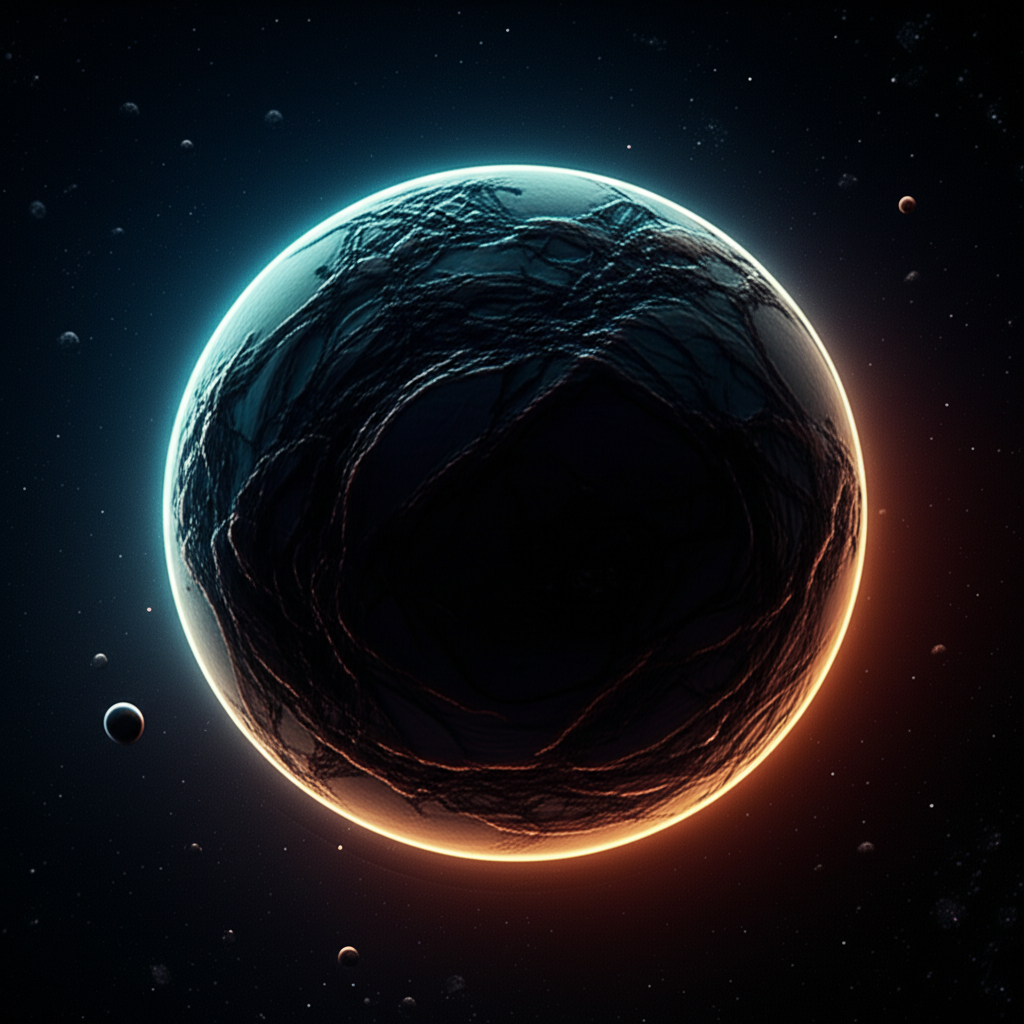
Cosmic Horror: Sphere of Silent Dread Unleashed
The Mariana Trench was a tomb of light and sound, a crushing void that swallowed everything human. Dr. Aris Thorne had dedicated his life to this abyss, seeking answers in the extremophiles clinging to hydrothermal vents, or the ghost-like leviathans that drifted through the eternal night. But the deep, Aris often mused, had its own sentience, a ponderous, ancient awareness that resonated not with sound, but with an overwhelming, absolute silence. His research station, Nautilus Prime, was his sanctuary and his prison, a beacon of human ingenuity perched on the rim of the Challenger Deep, 11,000 meters beneath the waves.
Today, however, the deep had delivered something new. Not a creature, nor a geological formation. A signal. Or rather, the profound absence of one. The long-range sonar arrays, usually a cacophony of echoes and pings mapping the seafloor, had registered a perfect, spherical void, an area of utter non-response. It was as if a section of the ocean, several kilometers in diameter, had simply ceased to exist acoustically. Aris, an astrophysicist by training, had gravitated to deep-sea exploration because the cosmos shared so many parallels with the abyssal plains: cold, dark, immense, and ultimately, indifferent. But this anomaly felt different. It felt… deliberate.
“Dr. Thorne, are you certain this isn’t a sensor malfunction?” asked Engineer Lena Hanson, her voice crisp over the comms, though tinged with the familiar tension of deep-sea operations. Her face, framed by practical braids, was etched with concern on the main screen.
“Negative, Lena. Cross-referenced all arrays. Recalibrated thrice. The anomaly persists. Perfectly spherical, perfectly silent. And it’s… moving. Slowly. Not drifting, but moving against the prevailing currents.” Aris leaned closer to the monitor, his gaze fixed on the stark, black circle on the holographic map. “It’s approaching the station’s outer perimeter.”
A shiver, colder than the abyssal waters outside, traced its way down Aris’s spine. He’d encountered the fear of the unknown before, but this was different. This was a primal apprehension, a sense of something fundamentally wrong with the universe. This was the first tendril of cosmic horror, uncoiling in the crushing pressure of the deep. The silence it promised was not peace, but a void.
The Deep’s Silent Eye
The discovery of the anomaly sent a ripple of unease through Nautilus Prime. Dr. Elias Vance, the station’s chief xenobiologist and a man known for his unflappable scientific detachment, was visibly disturbed. “A perfect sphere? In the natural world? What are we talking about, Aris? A giant metallic asteroid? A new organism? What could possibly absorb all acoustic vibrations and emit nothing in return?”
“That’s the million-dollar question, Elias,” Aris replied, trying to keep his voice level as he initiated the deployment of the Abyssal Eye, a specialized submersible designed for close-range observation. “Its density readings are off the charts – higher than osmium, even. And its surface temperature is exactly ambient, despite the size. No thermal signature whatsoever.”
The Abyssal Eye, a sleek, heavily armored craft, descended into the encroaching shadow. On the main viewscreen in the Nautilus Prime‘s command center, the abyssal plain slowly materialized, a vast, flat expanse of grey silt, broken occasionally by jagged rocks or bioluminescent flora. Then, it appeared.
It was immense. Far larger than initial sonar readings suggested. A colossal, obsidian-black sphere, easily three kilometers in diameter, suspended in the water column like an impossible pearl. Its surface was utterly featureless, absorbing the powerful spotlights of the submersible without a single reflection, a true black hole of light. It looked less like a physical object and more like a tear in reality, a gaping wound in the fabric of existence.
Silence. Not just the physical absence of sound due to the perfect absorption, but a profound, almost psychological silence that seemed to emanate directly from the sphere itself. The subtle hum of the Abyssal Eye‘s thrusters, usually a faint vibration in the observation deck, faded. The distant thrum of Nautilus Prime‘s life support, the gentle whir of the environmental controls – all seemed to recede, muffled and distant, as if a thick, invisible blanket had been thrown over the entire station.
“Spectrographic analysis indicates… nothing,” Lena reported, her voice strained. “No known elements. No molecular structure we can identify. It’s… solid, but not. It’s opaque, but doesn’t reflect. It defies all conventional physics.”
Aris felt a cold certainty blossom in his chest. This wasn’t natural. This wasn’t merely unknown; it was unknowable. This was an alien geometry, a manifestation of something utterly beyond human comprehension. This was not just a sphere; it was an object lesson in cosmic horror. A silent, perfect orb, hinting at forces that regarded humanity as less than a fleeting speck of dust. The quiet dread in the command center was palpable, each person lost in their own terrified contemplation of the impossible thing before them. The deep ocean, once a source of wonder, had become a conduit for pure, unadulterated terror.
As Aris stared at the impossible sphere, a peculiar sensation began to take hold. It was as if the very air in the command center grew heavier, not with pressure, but with an oppressive stillness. He could hear his own heartbeat, loud and erratic, a furious drum against the encroaching emptiness. He watched the Abyssal Eye circle the colossal object, its powerful lights vanishing into the sphere’s surface without a trace, as if swallowed whole by an abyssal maw. This wasn’t just a lack of sound; it was an active nullification, a draining of sensory input that was far more unnerving than any shriek or roar. The absolute silence emanating from it felt less like an absence and more like a presence, a watchful, indifferent entity regarding humanity’s crude attempts at understanding.
Aetherial Aphasia: The Descent into Stillness
In the days that followed, the sphere remained. Immobile. Silent. It had positioned itself directly over Nautilus Prime, casting an abyssal shadow that made the station’s powerful external lights useless. The submersible was brought back, its sensors fried, its cameras showing only static after its close encounter. The silence it emanated, however, persisted, growing stronger, more invasive.
It started subtly. The soft background hum of the station’s machinery, once a comforting constant, was now an irritating interference. Lena complained of phantom echoes, sounds that weren’t there but felt intensely real, like whispers brushing against her eardrums. Elias, the xenobiologist, began to talk less, his usual verbose explanations replaced by long, vacant stares at the main screen, the monstrous sphere dominating his view.
Aris felt it too. The lack of ambient noise was profound. He found himself straining to hear things – the shift of his clothes, the intake of his own breath. Any sound, when it did register, seemed jarring, out of place, almost painful. It was as if his auditory cortex was being starved, then violently overstimulated by the smallest disturbance. Communication within the station became difficult. Voices seemed to lose their timbre, flattening into monotone drones. Eventually, some crew members started avoiding direct conversation, preferring gestured signals or whispered, almost inaudible words. The encroaching silence was carving new pathways in their minds.
“It’s not just absorbing sound,” Aris muttered to Elias, one evening, watching the ghostly blue bioluminescence of creatures near the station, now seeming muted, as if the sphere was draining their light too. “It’s… sterilizing it. Deactivating it. Like an anti-sound field.” His voice sounded like it belonged to someone else, distant and hollow.
Elias merely grunted, rubbing his temples. “My extremophile cultures… they’re dying. The ones that rely on vibratory cues for reproduction. Even the ones dependent on specific light spectrums. It’s a systemic biological shutdown. The sphere is an extinction event in microcosm, Aris.” He shuddered. “A truly alien artefact, designed to erase.”
Reports from the surface were dismissed, then ignored. The satellite link became unreliable. Then, it too, succumbed to the overwhelming presence, swallowed by the immense silence that radiated from the sphere. Nautilus Prime was cut off. Alone in the deepest, darkest part of the ocean, with an entity that defied every known law of the universe.
The cosmic horror began to manifest not just externally, but within their own minds. Dreams became terrifyingly vivid, populated by formless shadows that spoke in the absence of sound, communicating pure, unadulterated dread. Waking hours were worse. Lena swore she could hear the pressure of the ocean itself, a groaning, tearing sound that vibrated directly in her skull. Another engineer, a usually placid man named Davies, began to hallucinate music, discordant symphonies played on instruments of agony. He eventually lashed out, smashing comms panels, screaming about invisible worms eating his ears, before the security team sedated him.
Aris found himself becoming increasingly fascinated, not with understanding the sphere, but with experiencing it. He would spend hours in the observation deck, staring into the impossible blackness, allowing the profound, active silence to wash over him. It wasn’t just quiet; it was a negative force, an anti-frequency that seemed to burrow into the very core of his being, replacing his thoughts with a profound emptiness, periodically punctuated by flashes of alien, chilling geometries. He felt small, insignificant, a fleeting ripple in an ocean of unimaginable, uncaring vastness. The universe, he saw with terrifying clarity, was not designed for human comfort, and this **
Leave a Reply